TAVNEOS remains available. For questions about the recent updates on TAVNEOS® and what this means for you, please review Amgen's Statement
This link is updated regularly to keep the community informed on the latest information.

Severe Active Disease
The American College of Rheumatology/Vasculitis Foundation guidelines define:1
- Severe vasculitis as having life- or organ-threatening manifestations
- Active vasculitis as having new, persistent, or worsening signs and/or symptoms attributed to the disease and not related to prior damage
ANCA = anti-neutrophil cytoplasmic autoantibody; GPA = granulomatosis with polyangiitis; MPA = microscopic polyangiitis.
Identifying Patients
Approximately 80%-90% of patients with AAV present with renal or other organ-threatening disease activity, which can be considered severe active disease3
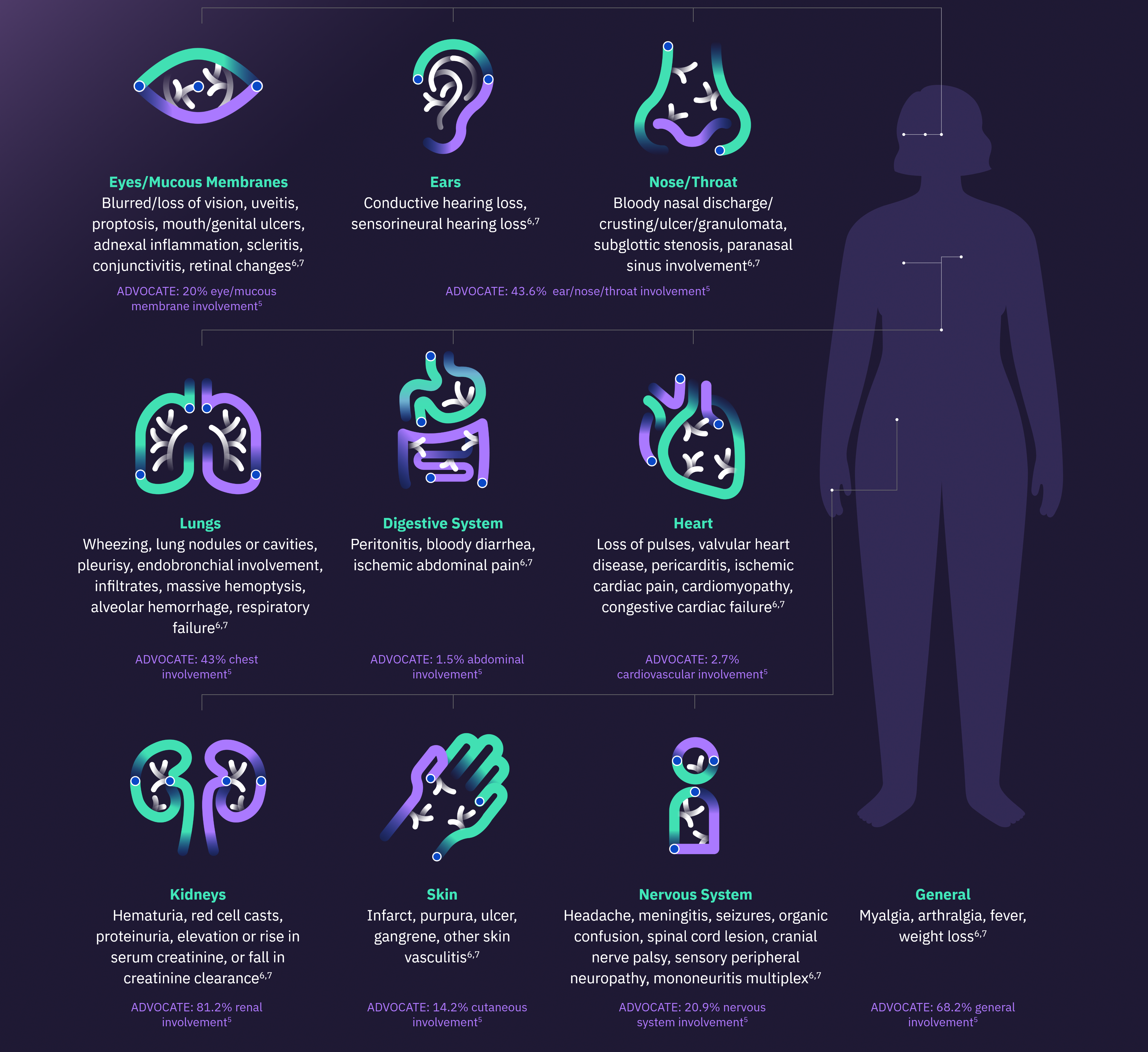
Patients in the ADVOCATE trial presented with a spectrum of clinical manifestations.4,5

Eyes/Mucous Membranes
Ears
Nose/Throat
Heart
Lungs
Digestive System
Kidneys
Nervous System
Skin
General
Myalgia, arthralgia, fever, weight loss6,7
ADVOCATE: 68.2% general involvement5

Eyes/Mucous Membranes
Blurred/loss of vision, uveitis, proptosis, mouth/genital ulcers, adnexal inflammation, scleritis, conjunctivitis, retinal changes6,7
ADVOCATE: 20% eye/mucous membrane involvement5

Ears
Conductive hearing loss, sensorineural hearing loss6,7
ADVOCATE: 43.6% ear/nose/throat involvement5

Nose/Throat
Bloody nasal discharge/crusting/ulcer/granulomata, subglottic stenosis, paranasal sinus involvement6,7
ADVOCATE: 43.6% ear/nose/throat involvement5

Heart
Loss of pulses, valvular heart disease, pericarditis, ischemic cardiac pain, cardiomyopathy, congestive cardiac failure6,7
ADVOCATE: 2.7% cardiovascular involvement5

Lungs
Wheezing, lung nodules or cavities, pleurisy, endobronchial involvement, infiltrates, massive hemoptysis, alveolar hemorrhage, respiratory failure6,7
ADVOCATE: 43% chest involvement5

Digestive System
Peritonitis, bloody diarrhea, ischemic abdominal pain6,7
ADVOCATE: 1.5% abdominal involvement5

Kidneys
Hematuria, red cell casts, proteinuria, elevation or rise in serum creatinine, or fall in creatinine clearance6,7
ADVOCATE: 81.2% renal involvement5

Nervous System
Headache, meningitis, seizures, organic confusion, spinal cord lesion, cranial nerve palsy, sensory peripheral neuropathy, mononeuritis multiplex6,7
ADVOCATE: 20.9% nervous system involvement5

Skin
Infarct, purpura, ulcer, gangrene, other skin vasculitis6,7
ADVOCATE: 14.2% cutaneous involvement5
Careful monitoring may help detect signs that your patients are experiencing severe active disease2,8-10



ENT = ear, nose, throat.
The Birmingham Vasculitis Activity Score (BVAS) is a clinical tool used to quantify systemic vasculitis disease activity primarily in clinical trials such as ADVOCATE13,14
There are 56 clinical features, grouped into 9 organ systems, and an “Other” category. Each clinical feature is given a numerical value according to its perceived clinical relevance as decided by expert consensus.5,7,15 A higher total BVAS equates to a more active vasculitic disease at the time of evaluation.7,14-16
While the BVAS is mainly used in clinical trials, understanding the spectrum of manifestations that could indicate active disease may be helpful in identifying patients with severe active GPA and MPA.14,15
The information shown below is adapted from the BVAS Version 3.0 and organized by organ system7
Abdominal
- Peritonitis
- Bloody diarrhea
- Ischemic abdominal pain
Cutaneous
- Infarct
- Purpura
- Ulcer
- Gangrene
- Other skin vasculitis
Nervous system
- Headache
- Meningitis
- Organic confusion
- Seizures (not hypertensive)
- Cerebrovascular accident
- Spinal cord lesion
- Cranial nerve palsy
- Sensory peripheral neuropathy
- Mononeuritis multiplex
Cardiovascular
- Loss of pulses
- Valvular heart disease
- Pericarditis
- Ischemic cardiac pain
- Cardiomyopathy
- Congestive cardiac failure
ENT
- Bloody nasal discharge/crusts/ulcers/granulomata
- Paranasal sinus involvement
- Subglottic stenosis
- Conductive hearing loss
- Sensorineural hearing loss
Renal
- Hypertension
- Proteinuria >1+
- Hematuria ≥10 RBCs/HPF
- Serum creatinine 125-249 μmol/L*
- Serum creatinine 250-499 μmol/L*
- Serum creatinine ≥500 μmol/L*
- Rise in serum creatinine >30% or fall in creatinine clearance >25%
Chest
- Wheeze
- Nodules or cavities
- Pleural effusion/pleurisy
- Infiltrate
- Endobronchial involvement
- Massive hemoptysis/alveolar hemorrhage
- Respiratory failure
Mucous membranes/Eyes
- Mouth ulcers
- Genital ulcers
- Adnexal inflammation
- Significant proptosis
- Scleritis/Episcleritis
- Conjunctivitis/Keratitis/Blepharitis
- Blurred vision
- Sudden visual loss
- Uveitis
- Retinal changes (vasculitis/ thrombosis/exudate/ hemorrhage)
General
- Myalgia
- Arthralgia/arthritis
- Fever ≥100.4° F
- Weight loss ≥2 kg
*Can only be scored on the first assessment.
GPA = granulomatosis with polyangiitis; HPF = high-power field; MPA = microscopic polyangiitis; RBC = red blood cell.
Testing and diagnostic considerations in severe active GPA and MPA
ANCA serology
- c-ANCA/PR3 antibodies are most frequently seen in GPA, and p-ANCA/MPO antibodies are most often associated with MPA8,17
- Although these antibodies are most frequently associated with respective diagnoses, ANCA positivity and specific antibodies vary by condition17
Frequency of ANCA types8
| ANCA-associated vasculitis | PR3-ANCA (mostly c-ANCA) | MPO-ANCA (mostly p-ANCA) | Other |
|---|---|---|---|
| GPA | 75% | 20% | 5% ANCA-negative |
| MPA | 30% | 60% | 10% ANCA-negative |
| ANCA-associated vasculitis | GPA |
|---|---|
| PR3-ANCA (mostly c-ANCA) | 75% |
| MPO-ANCA (mostly p-ANCA) | 20% |
| Other | 5% ANCA-negative |
| ANCA-associated vasculitis | MPA |
|---|---|
| PR3-ANCA (mostly c-ANCA) | 30% |
| MPO-ANCA (mostly p-ANCA) | 60% |
| Other | 10% ANCA-negative |
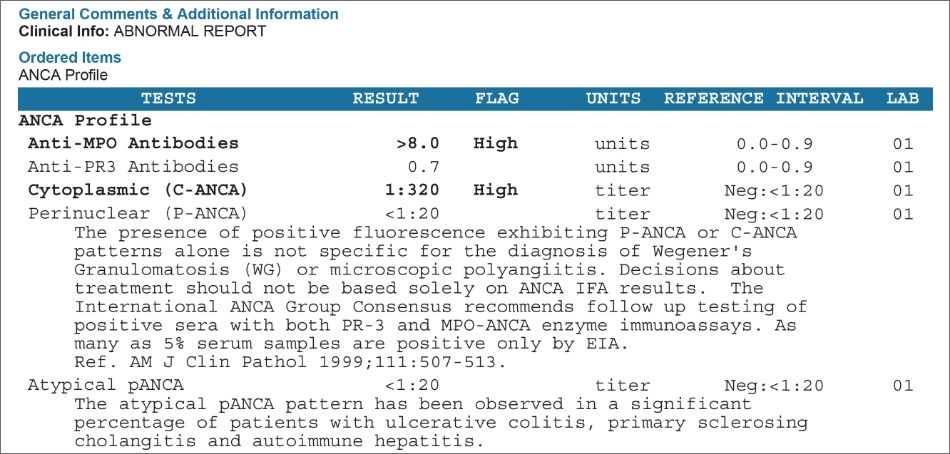
Example lab results for ANCA profile18
A full ANCA profile can be used in diagnosing
severe active GPA and MPA.
Biopsy2
Biopsy is another supportive tool that can be confirmatory, particularly in cases with renal, pulmonary, or skin involvement, but treatment should not necessarily be delayed simply to get a biopsy.
Pathology results from a kidney biopsy with AAV19
Renal biopsy in a patient with severe active AAV showing
- Severe interstitial inflammation (shown by the arrow)
- Segmental necrotizing and crescentic
glomerulonephritis (shown by the arrow)
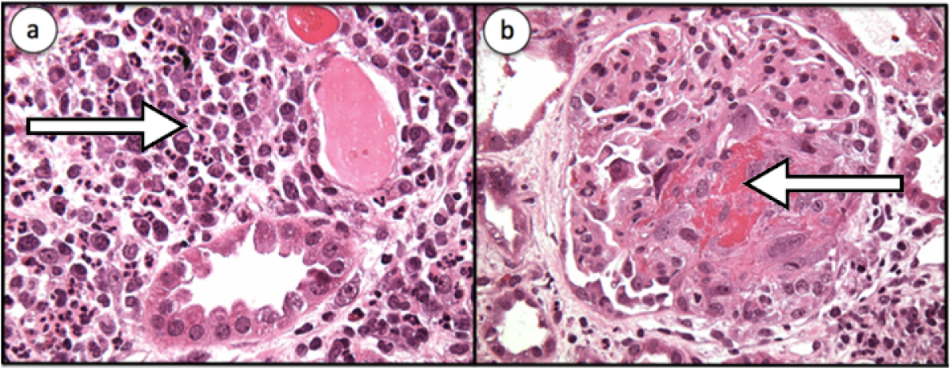
Image used with permission from Zagelbaum N, Zainab S, Gilani A, et al. Pulm Crit Care Med.
AAV = ANCA-associated vasculitis; ANCA = anti-neutrophil cytoplasmic autoantibody; c-ANCA = cytoplasmic-ANCA; GPA = granulomatosis with polyangiitis; MPA = microscopic polyangiitis; MPO-ANCA = myeloperoxidase-ANCA; p-ANCA = perinuclear-ANCA; PR3-ANCA = proteinase 3-ANCA.
ICD-10 codes can help identify patients with severe active GPA or MPA who may be appropriate for TAVNEOS®
This page provides a few examples of queries on electronic medical records or practice management systems that may be helpful in identifying appropriate patients for TAVNEOS®.
ICD-10 | |
|---|---|
| M31.3 | Granulomatosis with Polyangiitis (GPA)* |
| M31.30 | Granulomatosis with Polyangiitis (GPA) without renal involvement |
| M31.31 | Granulomatosis with Polyangiitis (GPA) with renal involvement |
| M31.7 | Microscopic Polyangiitis (MPA) |
| I77.6 | Unspecified Arteritis † |
| I77.82 | Anti-neutrophil cytoplasmic antibody (ANCA) vasculitis |
*GPA is formerly known as Wegener’s granulomatosis.
†The diagnosis is related to ANCA-associated vasculitis or GPA/MPA, specifically, and confirmed or awaiting confirmation using one or more lab tests: ANCA serum/biopsy/urinalysis.
ICD-10 codes and EMR can also help identify adult patients who may have undiagnosed severe active GPA or MPA
The following codes represent generalized symptoms that are common manifestations of GPA and MPA:
| ICD-10 Code | Manifestation |
|---|---|
| Vasculitic rash with systemic features | |
| L98.9 | Dermatosis |
| R23.3 | Purpuric |
| R50.9 | Fever |
| Respiratory symptoms | |
| R04.2 | Hemoptysis |
| R06.00 | Dyspnea |
| R06.02 | Shortness of breath |
| R05.9 | Cough |
| J45.909 | Asthma |
| J44.9 | Chronic |
| Renal disease | |
| N05.9 | Glomerulonephritis |
| ICD-10 Code | Manifestation |
|---|---|
| Ear, nose, throat/upper airway symptoms | |
| J32.9 | Sinusitis |
| J01.81 | Recurrent |
| H92.0 | Earache |
| H90.2 | Conductive hearing loss |
| M95.0 | Saddle nose |
| J95.5 | Subglottic stenosis |
| Eye symptoms | |
| H15.00 | Scleritis |
| H53.2 | Diplopia |
| Nerve symptoms | |
| R20.2 | Paresthesia |
| G62.9 | Neuropathy, neuropathic |
EMR = electronic medical record; ICD-10 = International Classification of Diseases, Tenth Revision.
The information on this page is informational and is not intended to be instructive with respect to clinical decision-making or billing and coding. Healthcare providers are solely responsible for clinical decisions and ensuring the accuracy and validity of all billing and claims. This is not a guarantee of coverage or reimbursement for any product or service.
You’ve seen the efficacy and safety data from the phase 3 trial. Now see how TAVNEOS® can help adult patients in these examples